
By the time The Hunger Games came out as a book, and subsequently a movie, I was already well into my 20s, in grad school trying to stay afloat, and, for whatever reason, not terribly interested in YA dystopias. I was aware of its existence, like Twilight (which I resisted like the plague), I was aware that there was a love triangle in which people took sides, that the films launched the career of actors like Jennifer Lawrence, and even vaguely aware of the story (I thought it a little weird and gruesome).
After all the films came out, I was finished with school, working, and generally much calmer, I ran across an article from Cracked.com, 5 Things Movie Dystopias Get Wrong About Dictatorships which references The Hunger Games a lot. I understand that it’s kind of a thing to make fun of Cracked, but I always enjoyed reading it, and even found a lot of their articles very insightful. While I may have gone to grad school for history, my first major in undergrad was politics, so I was intrigued. When I embarked on this journey to discuss political themes in films, I remembered that article and decided to have my own discussion here.
The Capitol: the good
First, it’s important to note that there are some places where The Capitol have done dictatorship right. I know it’s popular imagination that dictatorships will always fail in the end, but honestly you can say that of any government, and there are many good(good as in they are good at being dictatorships) and long-standing dictatorships around the world (Soviet Russia, North Korea, etc.), so maintaining the system is not impossible, but there is a trick to it.
Power
The Capitol in The Hunger Games has masterfully used nepotism and corruption to expand their power-base. President Snow grants favors to some, everyone in the Capitol itself is like his own inner circle. They do not have to send their children to the games, they are always fed, always have shelter, and enjoy luxuries. He, and the government, have also extended this out to some of the Districts closest to the Capitol, like District 2 most notably. They are still a District and therefore do have to get punished by sending kids to the games, but their kids are trained and are excited to go, and almost always win. Otherwise, they are a pretty well-off district with plenty of food and shelter and generally content with the system.
Force
Another key to successful dictatorship is to create a government monopoly on force thus making protests more difficult and deadly to any who would think to participate in one. I will say, the government have mastered this one in The Hunger Games. First, the games themselves are horrible, brutal affairs that are the center piece of the story, but there are also other, little things you can pick up on that demonstrate the brute strength of the Capitol. Outer districts, like Katniss’, are patrolled regularly by police with openly displayed weaponry. The citizens on the other hand are not allowed any weapons at all (Katniss has to stash her bow in a tree for when she goes hunting). Public executions, and punishments also seem to be common and serve as another reminder that the power resides fully in the hands of the government, and all you can do is lie there and take it.

Dealing with Political Opposition
President Snow can be quite cunning. He knows that political opponents pose a threat to his regime and there are basically two ways to deal with them; kill them, or make them work for you. Snow uses a combination of both of these tactics. He has no qualms killing off his political opponents, but the winners of the games are also potential political rivals. They are often popular, and they, as we learn in the second film, often also learn to wield a certain amount of political power and influence. Killing them would be problematic because of their popularity. Although he won’t shy away, his preferred strategy is to manipulate them. Make them work for him to promote his interests.
The Capitol: the not so good
The Capitol, for all that, I argue should not be a successful dictatorship, because they make some pretty basic mistakes.
Determination: The Future
It is important that you always make the outlook a rosy one. This can seem counterintuitive as dictators also use fear to justify the continued iron-fist rule of their government, but the trick is to always claim that the good times are head. Snow often comes off as a bit gloomy and there is a stark difference between grim determination (a good thing) and just plain grim (a bad thing). Even though the rosy future may be no more than an illusion, it should always be set up as the goal.

The future of Panem under the rule of the Capitol gives no hope for the future. It’s just a never-ending plod through the muck to your inevitable (and undoubtedly horrible) death. In such a scenario, there is little hope of a brighter future, and so you have nothing to lose if you revolt. But, if you can convince people that we can overcome and reach the promised land if we just stay the course, then people have something to lose, and revolution becomes less attractive because it puts that bright future at risk. As humans we can’t help but see the silver lining, and even if we know, rationally, that our present course is not a winning strategy, there is always that little part of us that says, “But what if it is? What if this does work, and I ruin it for everyone by not doing my part?” It is that little spec of doubt that keeps a dictatorship going, eliminate it and you are looking at a revolution.
Bread and Circuses
While we are on the subject of image, one important thing that all successful dictatorships rely on, is a bit of distracting spectacle. Why do you think North Korea is marching its missiles down the street every time you turn around? Why do all their army officers have a dozen or more decorations hanging on their uniforms? Because spectacle has a way of making us forget that our lives are terrible, and parades, ceremonies, and festivals provide great opportunities for people to forget their hardships for a little while. During the French Revolution, the government responsible for the Reign of Terror used the very public beheadings of aristocrats almost like a daily carnival.

They abolished the church (because the church was expensive and the bishops entitled twits), but they kept the festivals (giving them new names to celebrate Nationalism and the Revolution), because while the people after the revolution were scarcely better off than before, a good execution and a bit of a party can definitely take your mind off things.
The phrase “bread and circuses” dates back to Roman times and it is basically the idea that if people are well fed and given regular access to some kind of stimulating spectacle, they are basically content and care little for revolution. The Romans used fights to the death in the Colosseum and orgies. Now you may be asking, “But aren’t the Hunger Games meant to be like the fights in the Colosseum?” Well, you aren’t wrong, and in fact the name “Panem” actually comes from the Latin phrase panem et circenses (bread and circuses), but the Capitol in The Hunger Games is really not good at the first part, the part they took their name from, you know, the bread part. The vast majority of the people are starving and hunger breeds anger (hangry anyone?). There are circuses aplenty, at least annually, with the games, but the bread part of that strategy plays an integral role in placating the masses.
The Games
While we are on this subject, let’s talk about the games themselves. This is probably the biggest problem with the government in The Hunger Games. So, before we get into this, let me say first, that I know why the games are held. I get it. It’s to punish the Districts for an uprising that happened over 70 years ago. Let me just say, that is absolutely ludicrous! There are many problems with these games and a big one is that you are exacting ongoing punishment on a people for actions they (at this point in time) did not commit. If you are looking to breed resentment in a population then that’s a great way to go about it, but if you are looking for continued fear and subservience, there are better ways. You want to create fear, but not anger, and these games make the population angry.

While both the Games and the Colosseum fights offer a gruesome form of entertainment, a significant difference is that gladiators were normally grown adults, they were often foreign prisoners of war, or occasionally even signed up for the gig as their profession (a successful gladiator comparatively made even more money than most superstar athletes today). What they were not, were children of Romans snatched away from their families to fight other Roman children to the death. What makes the games even worse is that it would be not only like Roman children fighting other Roman children, but all the children living in the city of Rome (through nothing more than a quirk of fate) would be eternally exempted from that horror. All this accomplishes is breeding resentment in the vast majority of your population and setting up one group as entitled for no good reason, kind of like France on the eve of the Revolution.
The Enemy
As I mentioned above, fear is an important weapon you can use to justify your dictatorship and to argue for its continued existence, and the source of that fear is normally an enemy of some kind or another. The old saying, “an enemy of my enemy is my friend,” did not come from no where. Having a common enemy goes a long way toward uniting what may otherwise be bitter rivals. The American colonies were able to unite against their common foe, Britain, the World War II allies were able to unite against Hitler. Without that common enemy the colonies often squabbled among themselves not really united in anything, and while the UK and the US had long been allies, it was only the existence of Nazi Germany that made either one willing to even consider an alliance with Soviet Russia. Having a common enemy is a good thing.
In The Hunger Games the districts have a common enemy, created by the continued existence of the games and the vast difference between the lifestyles in the Capitol and the Districts, and that enemy is the Capitol and the government itself. So that’s not good, not if you are intending to establish a lasting regime. The trick practiced by successful dictators is that the enemy is common to all. Take North Korea for example. Below is an example of North Korean propaganda. It depicts a woman in the process of having her teeth pulled out by soldier and in another panel soldiers threatening to shoot a baby. Horrible. Those soldiers are American soldiers. The important thing here is that these are atrocities being performed by foreign soldiers against the population. It paints a picture of a frightening external enemy committing horrible acts against the population.

It is very possible, and even likely that these things are actually happening and it is in fact the government carrying them out, but important to the image and promoting a sense of unity and justification for extreme governmental measures is the grim warning that this is what our enemy wants to do to you and so if it means missing a meal or two so that a soldier on the front line gets to eat, then you do it because it’s part of the deal to keep us safe from the big bad Americans. It’s a collective struggle against a collective enemy.
Equality (in appearance)
Where the Capitol errs is that there is no external enemy, but instead they have set themselves up as the enemy and there are a number of little ways that they do this. First, there’s the games. They create a lasting division between the Capitol and the Districts and reaffirm that animosity every year with a new games and new children to torture.
While the games serve to disassociate the Districts from the Capitol, the Districts themselves are also split into groups based on their economic output. Having these divisions further fractures the entire society. District 12 identifies with 12 and has very little in common with 2. You can make some justification for divide and conquer that as long as the districts squabble amongst themselves they won’t be able to unite and fight the government, and convincing the individual districts that they have more in common with one another than with the Capitol is a challenge the rebellion must overcome. However, from a Capitol standpoint, a safer route, the one preferred by the world’s more successful dictators, is not to create arbitrary divisions at all. You want your people to identify with you as their government and not set up competing identities. There is one nation and everyone must come together and support it. That’s why North Korean propaganda constantly holds up the threat of American invasion, why fascists warn of the threat from the communists, why communists warn of the threat of the fascists; they are creating a common enemy in order to foster unity and identity with the nation and the government.
Finally, the most obvious way that the Capitol sets itself up as the enemy, a parasite living off the labors of Districts, is through the overt displays of wealth and indolence. The Capitol is a crazy place. In one scene Katniss and Peeta are at a party in the Capitol as tributes and one of the nameless attendees makes the flippant comment about throwing up so you can eat more a la the Roman Empire. They say this to two people who barely have enough food to live much less the ability to indulge to this crazy degree. The clothing in the Capitol is ridiculous. The city itself looks like some mixture of ancient Rome and Nazi Berlin and the residents all look like they walked right off some haute couture runway in Paris.

We are lead to believe that they do not work, rather they live their lavish lifestyles on the backs of the overworked Districts.
Most dictatorships make the attempt to downplay the wealth of the elite, or even make it a policy to outright hate wealth (on the surface). Good dictators do not use poverty as a weapon to wield against the population, but instead hold it up as an example of sacrifice for the greater good. Again, if me missing a meal means a soldier on the front line gets to eat, then I will take one for the team. Dictators themselves also try to project an image of humble perseverance in their own dress and accommodations. The Soviet poster below shows Stalin, dressed simply, burning the midnight oil, laboring for the good of the nation. Kim Jong Un always dresses simply in this quasi-military ensemble.
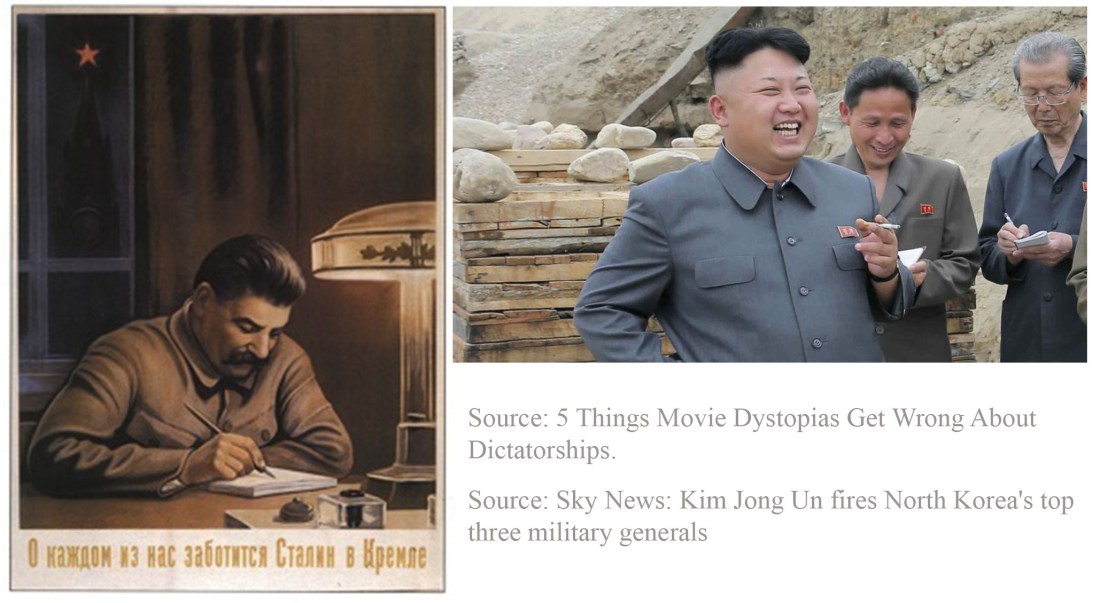
While we in other countries may be informed about Kim’s Rolls Royce, and Stalin’s stash of cash, you can be certain that it is not widely broadcast to the people living under their regime. Successful dictators keep a tight hold on the flow of information (something the Capitol did fairly well in the beginning of the franchise) and so news of the extravagance of the dictator and their cronies rarely makes the presses. If you dare to print it you won’t be around very long there after either, and so in a “Emperor’s New Clothes” fashion, we all pretend that they really are as humble as they appear, some may even start to believe it.
Overall, it stretches my belief that a government so poorly executing basic rules of successful dictatorship and doing everything in its power to foster anger manages to stay in power for over 70 years and the people just grin and bear it. The rebellion (which does a great job at a lot of these things where the Capitol failed and is well on its way to being a far more successful dictatorship than the Capitol until Katniss executes President Coin) really ought to have had more success before Katniss was even born much less had the chance to win the games and become their symbolic Mockingjay.
Sources:
5 Things Movie Dystopias Get Wrong About Dictatorships
7 Steps to Becoming a Dictator
How to Survive as a Dictator – a 10-step Guide
The Political Message of The Hunger Games
The Seven Habits of Highly Effective Dictators
 Lights, Camera, Politics!
I first want to say, WoW! this was really well thought out, precised, and articulate as this topic relates to real world events. I have to say that dictatorships leaves a bad taste in my mouth for it’s a prime example of complete control of a nation with no opposing side to lead a combat. Using Kim Jung Un as an example of a current dictator is very good. Just as you stated before, he uses fear to usurp the common freedoms most Americans have in this nation. Threatening to destroy families, level cities, and bombing neighboring countries shows nothing more than a man who is drunk on power (kind of like our celebrity and chief that I shall not name) and wants nothing more than to rule the world like any villain in a story. I will say that I saw some errors in spelling and punctuation in the first and second paragraph, but I’m bothered enough by it to nag. Who wants to sound like our mothers am I right? Anyway, i liked this post and can’t wait for more!
LikeLike
Cheers! I went back and fixed a few things. 😀
LikeLike